
Student Support Information
As a department of the University of Cambridge, the ADC Theatre is committed to preventing any form of discrimination, harassment, victimisation or sexual misconduct, among its staff, the student community and our customers. More detail on this policy can be found on the University's website.
We are committed to being a place in which people can feel safe, and those found to be carrying out discrimination, harassment, victimisation or sexual misconduct will be reported for investigation by the University's Office of Student Conduct, Complaints and Appeals (OSCCA), which may result in a permanent ban from the theatre.
Get support
The University of Cambridge follows a stepped care approach to student mental health and wellbeing.
This means that:
- We aim to offer, or refer you to, the support service best suited to your circumstances and goals.
- Different services work in a coordinated way to meet the diverse needs of our student population.
Student Support Services
Student Support offers the following mental health and wellbeing services:
- support for taught and research postgraduate students
- individual counselling
- specialist support for students with mental health issues
- groups and workshops on mental health and wellbeing topics
We also offer:
Access to services provided by Student Support depends on whether your course requires College membership and on your current location. This helps ensure that we can manage risk appropriately and work within relevant regulations.
You can learn more about eligibility for services, and about what happens if you are currently accessing a service and a change in your circumstances affects your eligibility, on the Student Support website.
Additional support across the collegiate University
A wide range of mental health and wellbeing support is also provided by Colleges, Departments and partner organisations across the collegiate University.
For more information, visit: Get support | Student Support
In addition to the above University resources, you can also go directly to the University Sexual Assault and Harassment Advisor who is able to offer support to survivors regardless of whether or not they choose to engage with any reporting processes. This guide, produced by students at Clare College, also has advice and resources on dealing with sexual harassment and assault, as well as more information on what avenues of support are available.
From October 9th 2023, the University will also have a dedicated Racial Harassment Advisor who can provide emotional and practical support to anyone dealing with these issues.
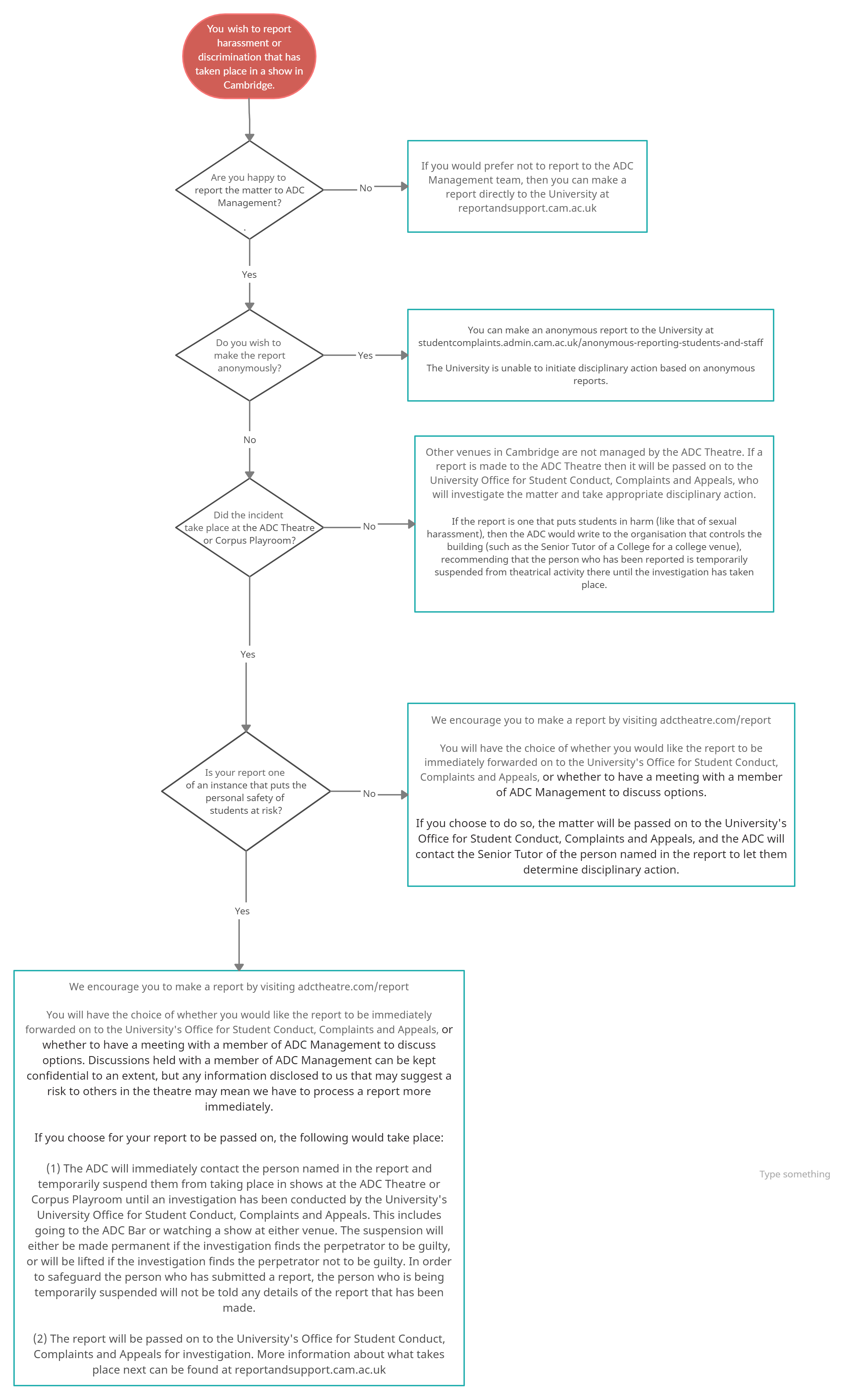
If you have been the subject of harassment while at the ADC Theatre or Corpus Playroom, or would like to report any misconduct, then please contact the Theatre Manager who will be able to guide you through what avenues of support are available, as well as what options you have for pursuing formal and informal complaints. Any reports made to the ADC Theatre are required to be passed on to OSCCA.
Anonymous reports can be made directly to the University's Student Complaints department here.
A named individual making a report will get the choice of whether their report is passed straight on to the University OSCCA, or whether to have a meeting with a member of ADC Management to discuss options. Discussions held with a member of ADC Management can be kept confidential to an extent, but any information disclosed to us that may suggest a risk to others in the theatre may mean we have to process a report more immediately.
We are committed to prioritising the safety of survivors and will take all steps possible to ensure that they are able to return to the ADC Theatre and Corpus Playroom feeling safe and supported in those environments. Disciplinary action is largely handled by individual colleges, but for our part, as far as is practicable, we will issue a temporary ban on theatrical activity while an investigation is taking place, which may, depending on the investigation's result, become a permanent ban.
The flow chart below explains how the process of reporting works:
The Incident Pathway document below also lays out options for taking incidents and complaints down other routes, such as informal discussion with/within student societies, and formal processes of bringing issues to the Theatre Management and Executive Committee.